Guide
15 Ways Dance Schools Can Sell Recital Videos and Digital Content
From a pre-sale checkbox at ticket checkout to season passes and archive sales: fifteen practical ways dance schools turn recital footage into revenue, sorted by effort.
The house lights come up.
A mom in row three is wiping her eyes with her sleeve. Her daughter was on stage for four minutes tonight. She'd watch those four minutes a hundred more times if anyone let her.
Nobody lets her.
The recording exists. A videographer shot it, or a tripod at the back of the house did. It'll sit on a hard drive in the studio office, next to last year's recording, and the one before that.
This is the strangest unsold inventory in the performing arts: the product is finished, the customer is crying in row three, and the transaction never happens.
So, fifteen ways dance schools and performing arts organizations can sell recital videos and digital content. Sorted by effort. The first five cost nothing but the decision to try.
Tier 1
Sell the recital recordings you already have
Zero new production cost. You shoot this footage anyway.
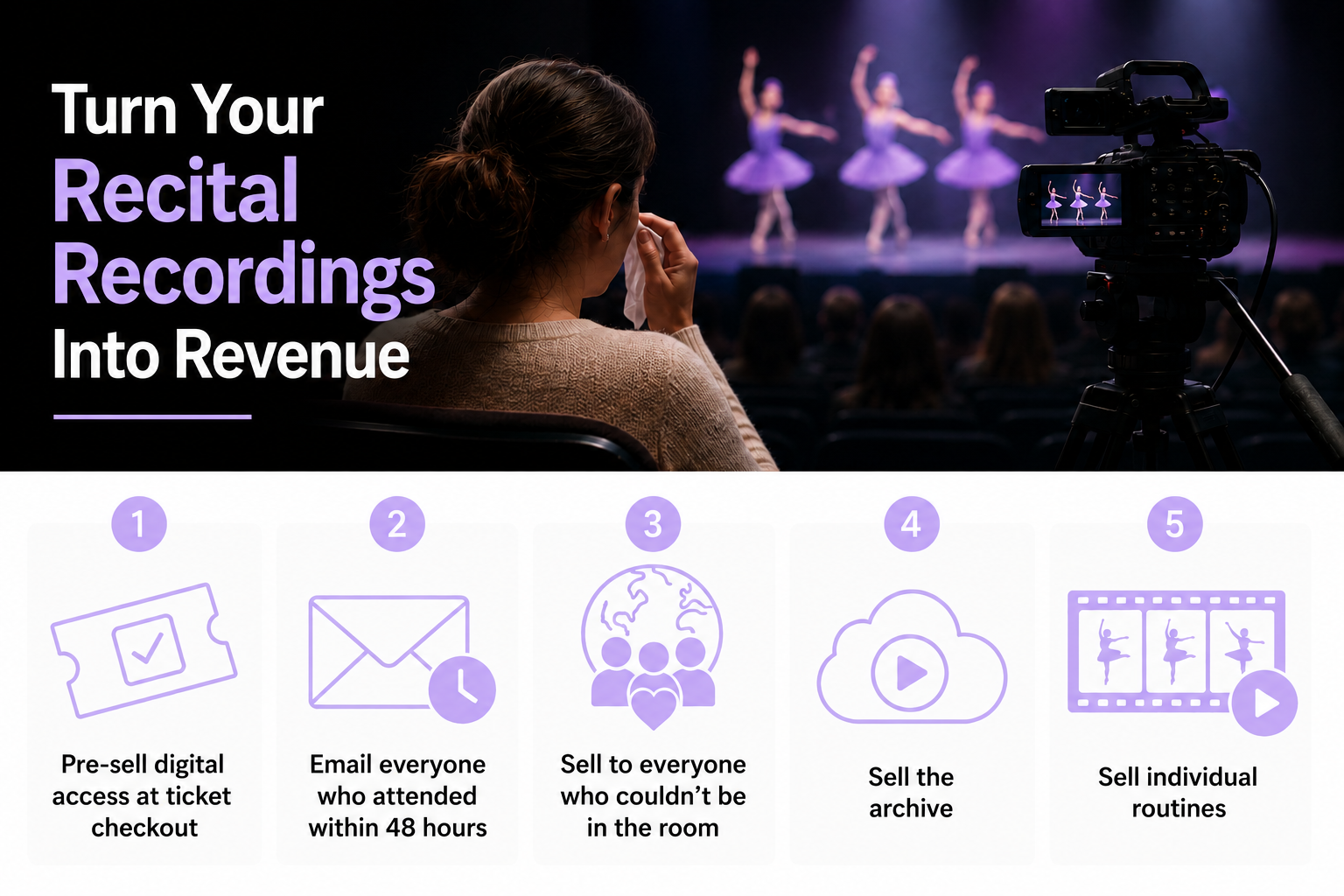
1.Pre-sell digital access at ticket checkout
Add one checkbox when families buy tickets: "Add lifetime digital access to the recorded performance for $25." That's it. That's the whole move. (I know. A checkbox. Stay with me.) This is a demand test disguised as a product. If 30% of ticket buyers check the box, you have proof (real money, not survey answers) before you've spent a dollar on anything else on this list. If nobody checks it, you've learned that too, for free. Pre-selling also kills the worst part of recital videos: chasing payments after the event, when everyone has already moved on.
2.Email everyone who attended within 48 hours
Buying intent for a recital video has a half-life, and it's short. The night of the show, a parent would pay almost anything to keep what just happened. Two weeks later it's a nice memory and a "maybe later." So email every attendee within 48 hours: Relive the night. Own the full performance. Not a month from now when the edit is color-graded. Within 48 hours, even if that means selling access today and delivering the polished file when it's ready. Sell inside the emotional window, or watch it close.
3.Sell to everyone who couldn't be in the room
The grandmother three time zones away. The dad who was traveling for work. Alumni who moved. Families with a conflict that night. Your live audience is the floor, not the ceiling. A 300-seat theater caps ticket revenue at 300 people. Digital access has no walls. For every seat you filled, there's usually at least one person who wanted to be in it and couldn't.
4.Sell the archive
Last year's Nutcracker. The 2023 spring showcase. The gala from before the pandemic. Those aren't memories. They're inventory. Families buy old recordings for the same reason they keep photo albums. Their kid was smaller then, and that version of them exists nowhere else. Put the archive behind a simple paywall and let people browse. You did the hard part years ago.
5.Sell individual routines, not just the full show
A recital has 40 numbers. A parent cares deeply about three of them. So offer both: the full performance, and their dancer's routines as individual purchases. Some families want everything. Most want their kid, in full quality, without scrubbing through two hours of other people's children. This is exactly what Dynamic Video Sales was built for: selling individual videos inside the full presentation.
Tier 2
One extra hour of filming, five premium products
Light production. You're already in the building with a camera.
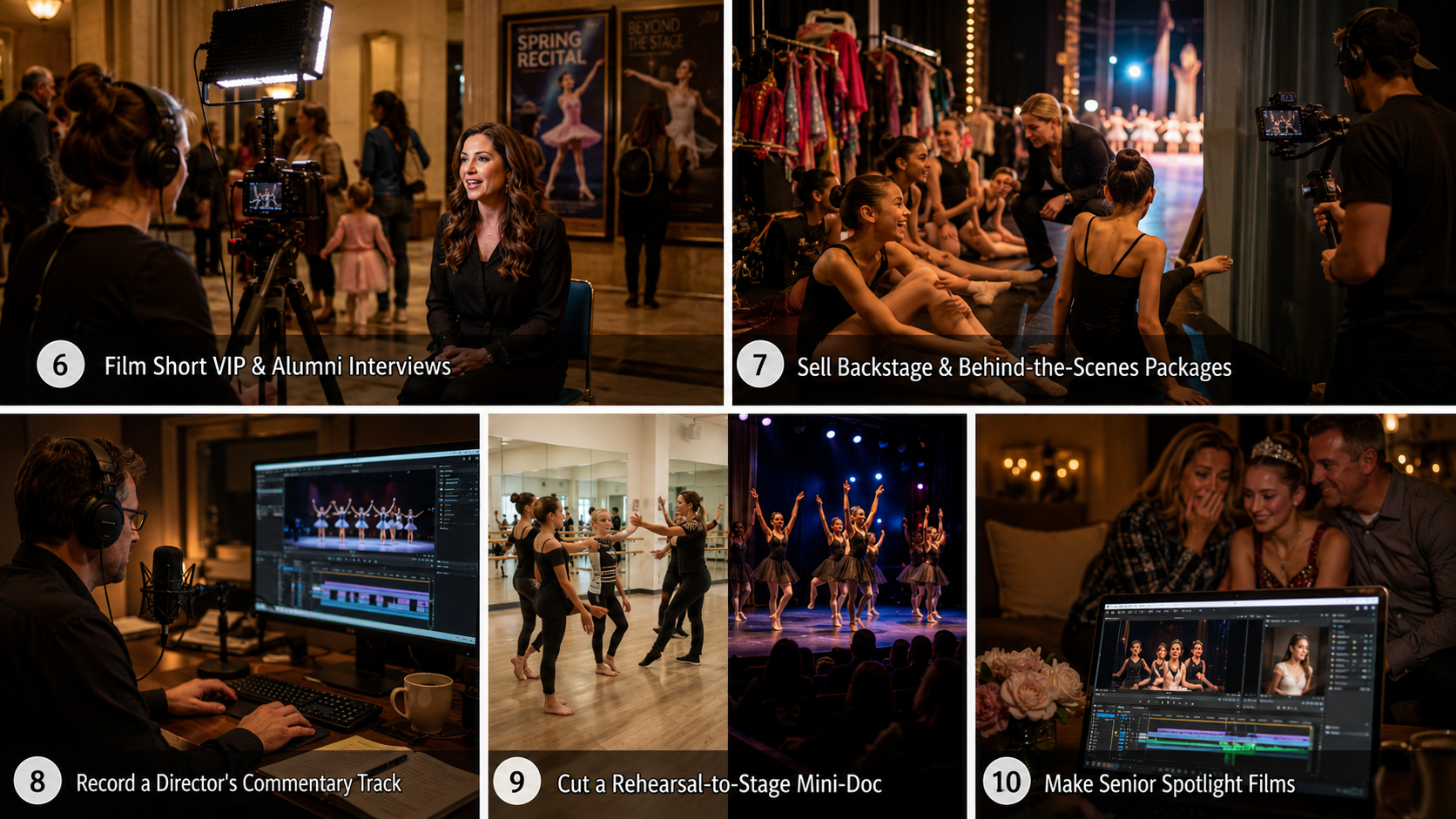
6.Film short VIP and alumni interviews
Set up one camera in the lobby. Ask board members, VIP ticket holders, and returning alumni a single question: "What does this school mean to you?" Sell the full interviews as bonus content. Clip the best twenty seconds for social media. One hour of footage, two jobs: a product for your superfans, and the most honest marketing you'll ever run.
7.Sell backstage and behind-the-scenes packages
The warm-up circle. The costume-room chaos. The five minutes before curtain when everyone goes quiet. Parents never get to see this. That's exactly why they'll pay for it. A phone, a steady hand, and twenty minutes backstage becomes a "Behind the Curtain" add-on that makes the standard recording feel basic.
8.Record a director's commentary track
Your artistic director sits down with the recording and talks over it. The inspiration. What to watch for in the second piece. The lift that almost didn't make the show. Commentary tracks turned DVDs into collector's editions. They do the same thing here. They turn a document into an artifact.
9.Cut a rehearsal-to-stage mini-doc
Six minutes: how the piece was built. September rehearsal footage. October cleanup. Opening night. Parents buy it because their kid is in the journey. Prospective families watch it and see what your training actually produces. One edit, two audiences. The second one enrolls.
10.Make senior spotlight films
A graduating dancer's years at your school, cut into one personal film. First recital to final bow. Families pay premium prices for this, not recital prices but keepsake prices. It's the difference between buying a photo and commissioning a portrait. And every senior film is a quiet message to every younger family watching: stay long enough, and this is yours too.
Tier 3
Turn one recital into recurring revenue
This is where a video stops being a side product and starts being a business line.
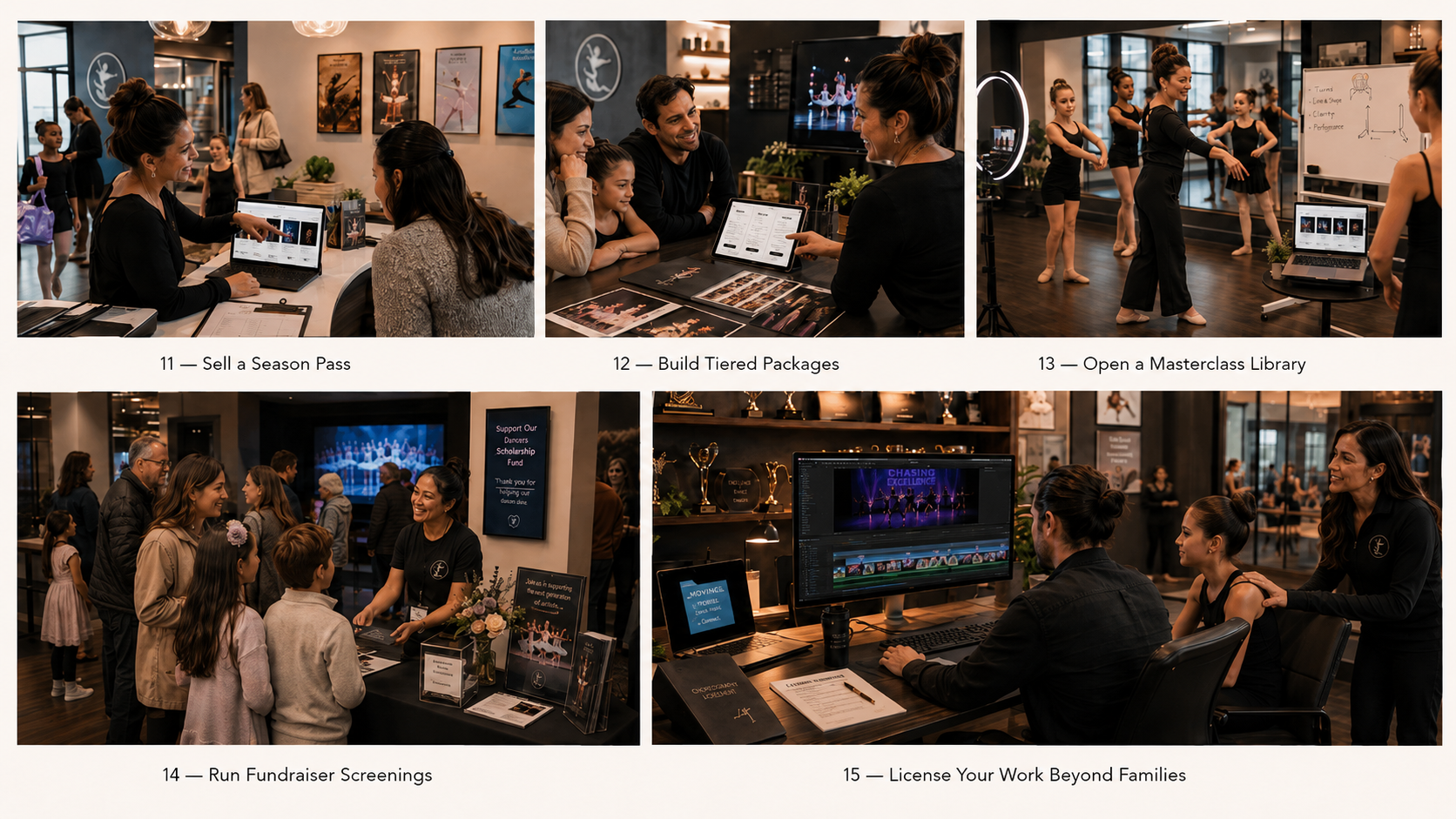
11.Sell a season pass
One price. Digital access to every performance this year. Families stop making four separate $25 decisions and make one $79 decision in September. You get predictable revenue before a single curtain rises, which is exactly when you need cash for costumes and theater deposits.
12.Build tiered recital packages
Stop selling one thing at one price. Sell three: Basic, the full recital recording. Family, the recording plus your dancer's individual routines and the photo gallery. Legacy, everything plus backstage footage and the interviews. Some families always buy the top tier. Right now you're not offering them one.
13.Open a masterclass and technique library
Your instructors give the same corrections every week. Record the best of them once. Turnout fundamentals. Spotting. Audition prep. Sell access to your own students as a practice tool, then to dancers anywhere. This is the moment a school stops being only a local business and becomes a content brand with a building attached.
14.Run fundraiser screenings
Sell digital access where part of every purchase funds scholarships or next season's costumes. Here's who buys: supporters who never attend a single show. Local businesses. Extended family. They're not really buying a recital video. They're buying a way to back the school that doesn't require a Saturday night. Same recording. New audience. The money does double duty.
15.License your work beyond your families
Competition pieces sold to other studios as study material. Clean, well-shot performances packaged as audition reels for dancers applying to university programs and companies. This is the deepest end of the pool, and most schools never need to swim here. But it's worth knowing the pool has a deep end: the work you're making has value past your own lobby.
The pitch underneath all fifteen
Back to the mom in row three.
She's at every show, at every school, every season. She is demand in its purest form, already moved, already sold, holding nothing.
You don't have to guess whether people will pay for your work. You're already making the work. Record what you're already doing, put it somewhere people can buy it, and let your audience answer with their wallets.
The data costs almost nothing to collect. And the checkbox is waiting.
FAQ: Selling dance recital videos online
Most studios land between $20 and $40 for lifetime digital access to a full show, with individual routines as smaller add-ons and keepsake products (senior films, legacy bundles) priced well above that. The honest answer is to test. The checkbox at ticket checkout tells you what your families will pay before you commit to anything.
Two things to sort out first: media releases from families (most studios already collect these in enrollment paperwork, so check yours) and music rights for the songs in your show. A license to perform music live is not the same as a license to sell recordings of it, so talk to your music licensing provider before putting a show behind a paywall. Not legal advice. Just the two questions to ask before you sell.
Four things: a paywall that handles both full-show and per-video purchases, download protection, household or device login limits, and enough automation that you're not emailing files by hand. Get those four right and everything on this list becomes a pricing decision instead of a logistics problem.
Before the show, and within 48 hours after it. Intent peaks at the performance and decays fast. The pre-sale checkbox captures the front of the window; the 48-hour follow-up email captures the back.
What studios say
“MediaZilla allows me to distribute extremely long 4K recital videos so families can watch on phones, tablets, TVs, and computers from anywhere.”
“Best platform for dance recital delivery. It removes DVD chaos and gives families a premium, secure experience.”
“MediaZilla changed how I deliver and monetize dance videos, creating new revenue streams.”
Ready to turn your recital into revenue?
Set up your paywall, sell full shows and individual routines, and let families buy while the emotion is still fresh.
Try MediaZilla free