How Much to Charge for a Dance Recital Film in 2026 (With the Math)
By MediaZillaUpdated
Free migration offer
Move your Vimeo On Demand library to MediaZilla in 14 days - or we pay you $1,000.
$8,100. That is what a 180-student studio clears on recital video alone at $45 per family wrapped into tuition. The same studio selling the exact same film a la carte at $45 clears $4,455. Same film, same families, almost double the revenue. The pricing model matters more than the price.
$8,100. That is what a 180-student dance studio clears on recital video alone when the fee is wrapped into tuition at $45 per family. The same studio selling the exact same film a la carte for $45 clears $4,455. Same film. Same families. Almost double the revenue.
Pricing a dance recital film is not a creative decision. It is a math problem with four known variables: price per unit, attach rate, delivery cost, and buyer lifetime. Get the model wrong and you leave thousands of dollars on the stage every June.
Below is what the market pays in 2026, the four pricing models that work, and the math behind each one.
What the Market Actually Pays in 2026
Public studio order forms for the 2026 recital season land in a tight band. Most sit between $26 and $55 per video, with $35 as the single most common price point. A full season bundle covering two or three shows runs $100 to $160. Studios that charge per family on registration tend to price between $35 and $45 and attach the fee at the same time parents pay tuition for the final month.
One Illinois studio charges $35 per show and $120 for all three shows on its 2026 order form. One Ontario program bundles a $26 recital video into tuition and lists it as a line item on the registration page. One Utah studio makes the digital download part of a season fee that also covers rehearsal time and costume handling.
The pattern is clear. Parents expect a professionally shot recital film to cost less than a dinner out. Price it like a souvenir and they buy. Price it like a camera rental and they do not.
Three Pricing Models and the Math Behind Each
Four if you count baked-into-tuition, which is the simplest model and the one most studios ignore because it feels like giving the film away. It is not. It is pricing it correctly as part of what every family is already paying.
| Model | Typical price | Attach rate | Note |
|---|---|---|---|
| A la carte per video | $35 to $55 | 40 to 65 percent | Highest price per buyer. Lowest attach rate. Needs pre-sales to work. |
| Per family add-on | $26 to $45 | 70 to 85 percent | Rolled into tuition or add-on at registration. Steady, predictable. |
| Season pass or tiered | $79 to $160 | 20 to 35 percent | Lower volume. Highest revenue per buyer. Family tier unlocks TV apps. |
| Baked into tuition | Costed in at $20 to $35 | 100 percent | No separate transaction. Zero support tickets. Lower perceived value. |
Price per unit matters less than attach rate. A $55 a la carte film that reaches half the families earns less than a $35 per-family fee that reaches 80 percent. Volume outruns price almost every time.
The 180-Student Studio Example
Pick a studio with 180 enrolled dancers across pre-school through teens. One June recital, two shows. Here is the season math across the four models.
| Scenario for a 180-student studio | Season revenue | Math |
|---|---|---|
| A la carte at $45, 55 percent attach | $4,455 | 180 students x 0.55 x $45 |
| Per family at $35, 80 percent attach | $5,040 | 180 x 0.80 x $35 |
| Per family at $45 wrapped into tuition | $8,100 | 180 x 1.00 x $45 |
| Season pass at $99, 25 percent attach + family tier at $149, 10 percent attach | $7,137 | 180 x 0.25 x $99 + 180 x 0.10 x $149 |
The per-family-wrapped model wins by a mile. Not because the price is higher. Because the attach rate is 100 percent. Every family pays. No chasing late buyers. No support tickets about broken download links.
The season pass model comes in second and is the right choice for studios that already run subscription programs. The a la carte model comes last and is where most studios still sit by default.
What Raises Attach Rate Without Raising Price
Open pre-sales before dress rehearsal
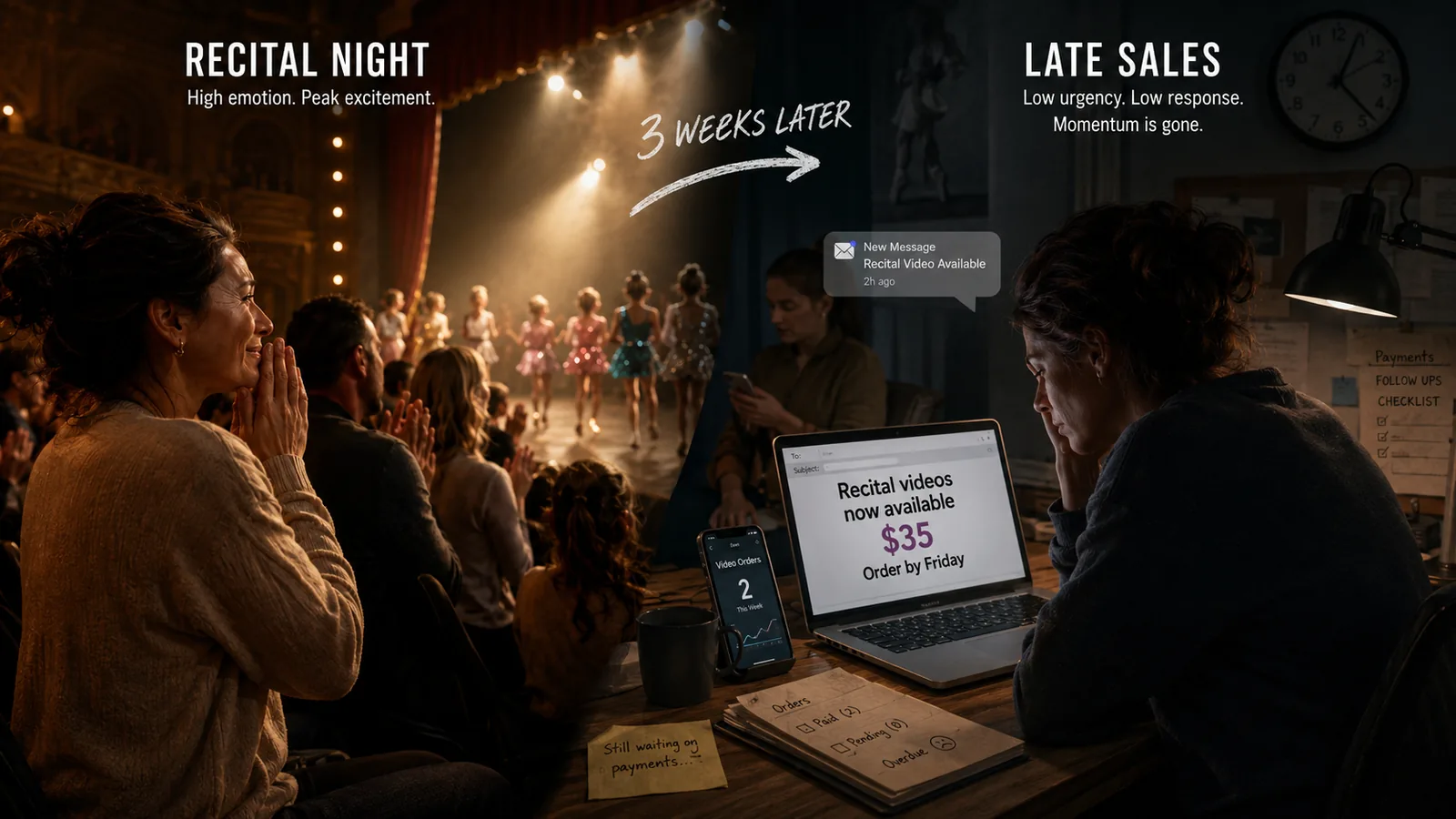
Emotion peaks the week of the show. Parents pack dance bags, iron costumes, and remember how fast their kid has grown. That is when the buy decision is easiest, not after they have already seen the show on a phone. Studios that open pre-sales 7 to 14 days before the recital see conversions roughly double post-recital rates.
Bundle grandparent access
Grandparents are the second buyer in every recital family. They watch on a living room TV, not a browser. A family tier that includes native apps for Apple TV, Fire TV, Roku, and Android TV lifts average order value by $15 to $25 and gives parents a reason to pick the higher tier.
Give returning families a reason to come back
A buyer who kept access to last year's recital is five times more likely to buy this year's. Platforms that keep buyer access alive across seasons compound into real revenue by year three. Platforms that end access when a plan lapses reset the attach rate to zero every year.
Delivery Choice Changes the Economics
Three delivery paths cover almost every studio. Each changes what you can charge.
USB or DVD. Still common. Supports a $45 to $55 price because the physical object feels valuable. Costs you the drive, the printing, and a handoff. One parent copies it and it reaches a group chat within a week. Zero residual value to you after the handoff.
A link to a cloud folder. Google Drive, Dropbox, WeTransfer. The default for studios that have not thought about this. Price ceiling drops to about $25 because parents do not perceive a Drive link as a product. No branding, no protection, no apps, no analytics. If you cancel the plan, access ends.
A branded delivery platform. A studio-branded page with a chaptered menu, native TV apps, DRM encryption, built-in checkout, and lifetime buyer access. Supports $45 to $160 pricing because parents see a product, not a file. MediaZilla ships all of that on every plan with zero platform commission on sales.
How to Price Your Next Recital
- Pick one pricing model. Not two. Two creates confusion and lowers attach rate.
- If your studio has strong parent communication, test per family at $45 wrapped into June tuition. This is the highest expected revenue for most studios.
- If your studio sells a la carte today, keep the base price at $35 for digital and add a $45 family tier that unlocks TV apps for grandparents.
- Open pre-sales 10 days before the show. Email parents from a studio address, not a generic no-reply.
- Keep buyer access alive across seasons. A returning buyer costs you nothing and pays you full price every year.
- Put the film on a platform that protects it. A USB handed to a parent is a free YouTube upload waiting to happen.
If MediaZilla is the right platform for your delivery, the free trial gives you branded sales, DRM, native TV apps, and 0 percent platform commission in under 30 minutes. For a step-by-step on recital pre-sales, see how dance schools pre-sell recital videos.
Frequently Asked Questions
What is the going rate for a dance recital film in 2026?
How do I decide between a per-family fee and a pay-per-video model?
Should I charge extra for digital versus USB or DVD?
How many families actually buy the recital film?
What is the easiest way to double recital video revenue?
How do I protect the film from being shared or ripped?
Can I sell recital films under my own studio branding?
What happens to past buyers if I cancel the platform later?
Price the film like a souvenir. Collect every family. Deliver on a platform parents and grandparents can actually use. That is the whole playbook, and it adds up to thousands of dollars every June.
Featured Resource
Migrate from Vimeo On Demand before November 20
Apply for a free MediaZilla migration spot. Approved libraries move in 14 days - or we pay you $1,000.
Apply for free migration