How Independent Filmmakers Actually Earn Money: Nine Income Streams, What Each Pays, and How to Combine Them
By MediaZillaUpdated
Free migration offer
Move your Vimeo On Demand library to MediaZilla in 14 days, or we pay you $1,000.

Nine ways independent filmmakers get paid, what each one costs, the catch with each, and the math most guides skip. Pick the stack that fits your film.
Nobody publishes what the average independent film earns. Not the festivals. Not the platforms. Not the guides that say they know.
That tells you something. The filmmakers who keep making films don't depend on one source of money. They stack several. One pays for the film. One launches it. One keeps paying for years. And client work pays the rent while all of that happens.
Here's the map. Nine streams. For each one you get what it pays, what it costs, the catch, and who should do it. Where we could check a number on the platform's own page, you get the number. Where we couldn't, we say so.
One number to treat with suspicion. One guide says a self-distributed feature with no name recognition earns $4,000 to $8,000 over 18 months. It's a marketing blog. Use it as a rough guess, not a plan.
The Income Stack
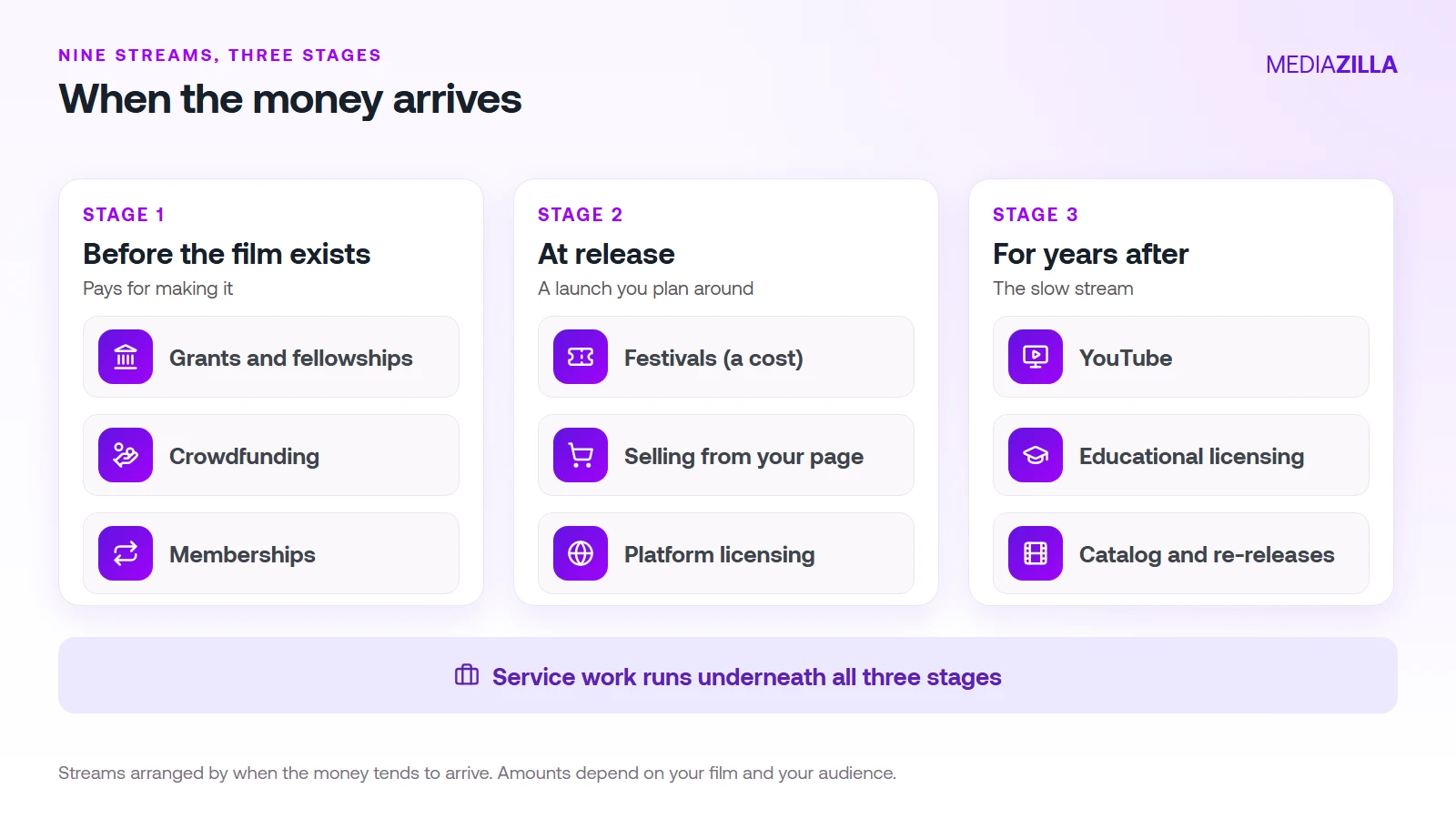
Three stages. Money before the film exists pays for making it. Money at release is the burst you plan a launch around. Money after is the slow stream that can matter most over five years. Client work runs underneath all three.
Most filmmakers only think about stage two. That's the mistake.
Stage 1: Get Paid Before the Film Exists
1. Grants and fellowships
- Pays you.
- A grant for a selected project, usually in stages.
- Costs you.
- Application time. Sometimes a fee.
- The catch.
- It's competitive and focused. Sundance's Documentary Fund gives priority to independent nonfiction with budgets under $1.2 million, according to its site. The 2027 cycle deadline was June 15, 2026, so it's closed. Its 2026 round funded 19 nonfiction projects with more than $1 million in total. We only verified Sundance. Check other programs on their own pages.
- Do it if.
- You're making a documentary or nonfiction film with a clear subject and a team.
2. Crowdfunding
- Pays you.
- Backers pledge toward a goal. You get the funds after the campaign.
- Costs you.
- On Kickstarter, most guides cite a 5% platform fee, plus payment processing of roughly 3 to 5% and a small fixed fee per pledge. That's about 8 to 10% in total. We couldn't read Kickstarter's own fee page, so confirm it before you launch. Seed&Spark's FAQ says it charges no platform fee and only passes on Stripe processing.
- The catch.
- Crowdfunding converts an audience. It doesn't create one. No audience, no campaign.
- Do it if.
- You already have a community around you or around the subject.
3. Memberships
- Pays you.
- Supporters pay monthly for behind-the-scenes content, early access, or your next film.
- Costs you.
- Patreon's pricing page lists 10% of the income you earn, plus payment processing, currency conversion, and payout fees. It doesn't give a number for those extras.
- The catch.
- It's a promise to post something every month. Miss it and people cancel.
- Do it if.
- You make a series, or you show your process.
Stage 2: Get Paid When You Release
4. Festivals: treat them like ad spend
- Pays you.
- Mostly nothing. They pay in attention, credibility, and the occasional offer.
- Costs you.
- Typical fees run about $20 to $150. Sundance's 2027 schedule shows timing matters: features were $80 early, $100 at the deadline, and $125 late, and shorts were $55 early. FilmFreeway suggests budgeting around 3 to 5% of your film's budget for submissions.
- The catch.
- Fees are often non-refundable. Waivers usually go to people who ask. Keep the list short. Our screener guide covers the link.
- Do it if.
- The film needs a premiere or a press hook.
5. Selling from your own page: the only stream where you keep the customer
- Pays you.
- Buyers pay you directly for a rental or purchase.
- Costs you.
- Stripe lists 2.9% plus $0.30 per US card payment. On top of that, Gumroad lists 10% plus $0.50 per direct sale. A flat-plan platform such as MediaZilla charges a yearly plan instead of a percentage.
- The catch.
- Nobody sends you buyers. You bring them.
- Do it if.
- Always, in some form, even if you also license. Read how to sell a film online.
6. Licensing: rent someone else's audience
- Pays you.
- A platform lists your film and pays per sale, per view, or per ad.
- Costs you.
- Amazon's Prime Video Direct says it's free to submit. Its agreement text pays 50% of the purchase price for purchases and rentals. Subscription payments follow "hours viewed" on a rate card we couldn't read. Ad-supported payments are based on hours viewed or net advertising receipts, which is cash received less 15%. Roku lists 80% to the publisher on payments it collects. Apple's Small Business Program page lists 15% for developers with up to $1 million in proceeds.
- The catch.
- Read the term. The Prime agreement we read is non-exclusive and runs in perpetuity until terminated, and Amazon has sole discretion over which titles it licenses. Letterboxd Video Store is curated, and its revenue split isn't published. See Letterboxd vs selling direct.
- Do it if.
- The film benefits from shoppers who already browse there, and you have no audience of your own yet.
Stage 3: Get Paid for Years
7. YouTube: free reach, with rules
- Pays you.
- Ad revenue, memberships, and tips once you join the Partner Program.
- Costs you.
- Nothing to join, but you have to qualify. YouTube's help page lists 1,000 subscribers with 4,000 qualified watch hours in the last 12 months, or 1,000 subscribers with 10 million qualified Shorts views in the last 90 days. Review typically takes about a month. YouTube pays 55% of net ad revenue on long-form video, 45% from the Shorts pool, and 70% on memberships and Super Chat.
- The catch.
- The clock is ticking. YouTube says that starting February 1, 2027, entry for new creators moves to 8,000 qualified watch hours in 365 days, or 20 million Shorts views in 90 days, plus 1,000 subscribers. Current members aren't affected. Its reused-content policy also applies to your whole channel, and its pages don't say whether a full-length film can earn ad revenue. Check before you count on it.
- Do it if.
- You can post trailers, behind-the-scenes, or a series that sends people to your paid film.
8. Educational and library licensing
- Pays you.
- Libraries and schools license a film by the title or in collections. Some licenses run one or three years. Some give perpetual access.
- Costs you.
- Usually a distributor's share. We found no published revenue split.
- The catch.
- One university guide says academic library purchases can supply a significant part of income for documentary filmmakers with niche subjects. In 2026, ITVS and Kanopy announced a program to license educational and library rights directly from filmmakers on ITVS co-productions. Check term length, who negotiates, and which rights you keep for direct sales.
- Do it if.
- Your documentary is about something people study.
9. Client work: it pays the rent
- Pays you.
- Clients pay you for commercial, corporate, wedding, and event video.
- Costs you.
- Your time, and your film's schedule.
- The catch.
- One marketing guide lists corporate video at $3,000 to $25,000 per project, creator services at $500 to $5,000 per video, and events at $1,500 to $8,000. Treat those ranges as rough.
- Do it if.
- Almost everyone, at least at first. Raise your rate with add-ons. See how event videographers raise revenue per client.
The Math Most Guides Skip
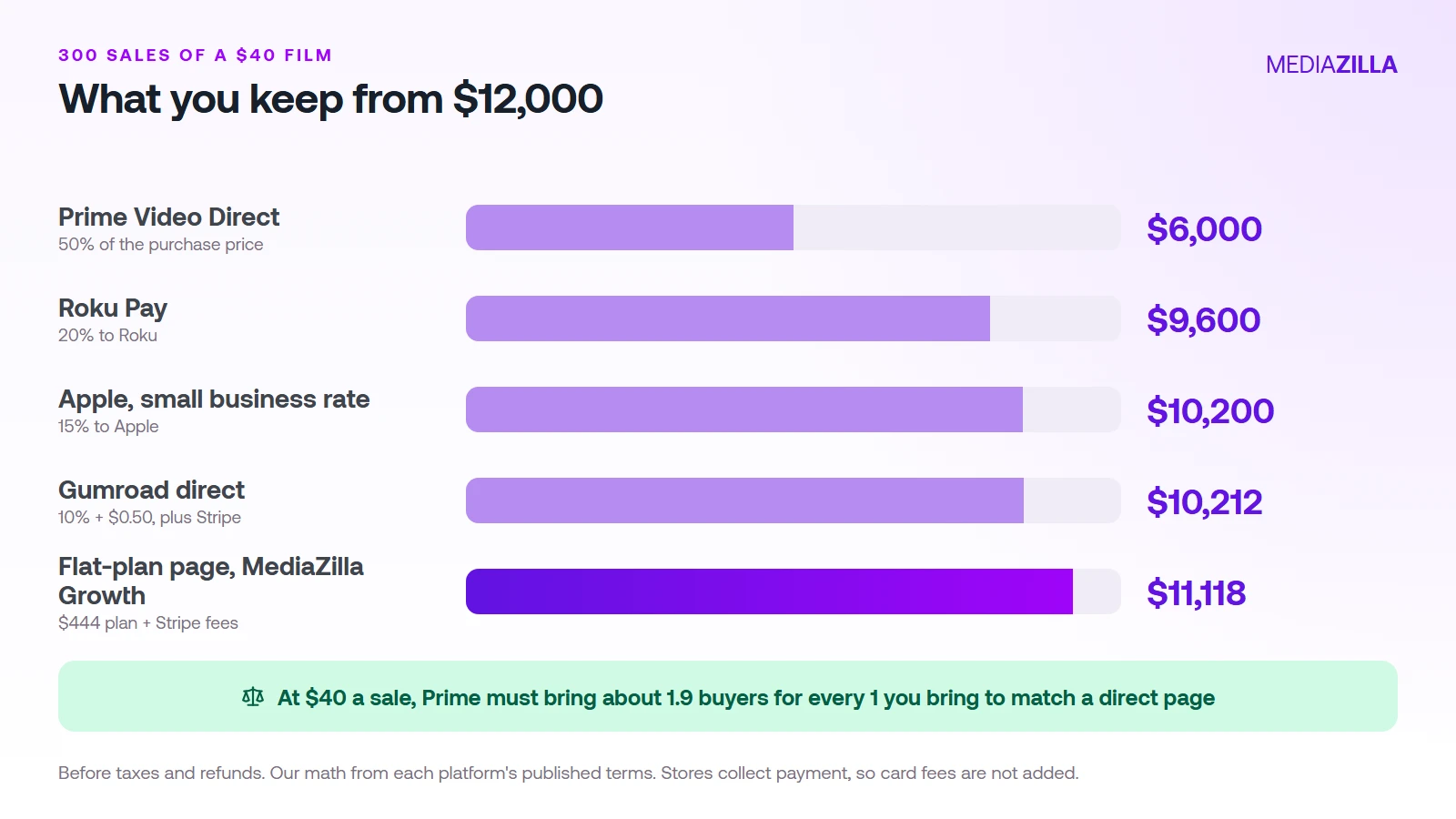
300 sales of a $40 film. $12,000 gross. Here's what each route leaves you, before taxes and refunds. This is our math from each platform's published terms.
| Route | Platform cut | You keep |
|---|---|---|
| Prime Video Direct, purchase or rental | 50% of the purchase price | $6,000 |
| Roku Pay | 20% | $9,600 |
| Apple, small business rate | 15% | $10,200 |
| Gumroad direct | 10% + $0.50, plus Stripe | $10,212 |
| Flat-plan page, MediaZilla Growth | $444 a year, plus Stripe | $11,118 |
Now the number that matters: 1.9.
At $40 a sale, a direct page keeps about $38.54 after Stripe's fee. Prime's 50% keeps $20. So Prime has to bring about 1.9 buyers for every 1 you bring yourself to match your take, before counting your plan fee.
No audience? Take the deal. Real audience? Don't hand over half.
Same logic for crowdfunding. Raise $12,000, pay 8 to 10% in total fees, keep $10,800 to $11,040.
Pick Your Stack
Our suggestions, not rules.
A short film and no audience yet
- Start with.
- Free reach. Post the film or a cut of it, and collect emails.
- Add.
- A small festival list for credibility.
- Skip for now.
- Paid platform licensing and crowdfunding, until people know your name.
A feature with a festival run
- Start with.
- A page you control for sales, so festival attention turns into buyers.
- Add.
- One non-exclusive licensing route, and YouTube trailers.
- Skip for now.
- Exclusive deals you haven't read twice.
A documentary about a subject people care about
- Start with.
- Grants before. Community sales after.
- Add.
- Educational and library licensing, and a direct page for the community.
- Skip for now.
- Chasing every festival.
A series maker or a creator with followers
- Start with.
- A membership and YouTube.
- Add.
- Direct sales of finished films and extras.
- Skip for now.
- Platforms that take the buyer relationship.
Eight Questions Before You Sign
Ask these. Write down the answers.
- Is it exclusive, and for which territories and formats?
- How long is the term, and how do I end it?
- Who owns the buyer's data, and can I export it?
- When and how often am I paid, and is there a payout threshold?
- What reporting do I get, and can I audit it?
- What fees come out before my share is calculated?
- What happens to my film and my rights when the deal ends?
- Does it limit what I can sell myself?
Where MediaZilla Fits
MediaZilla is stream 5. A branded film page, a checkout, and viewing on the web and on smart TVs.
Here's the plan to look at: Growth, $37 a month billed annually, with 0% platform commission. Buyers pay into your own Stripe account, and MediaZilla takes nothing from the sale. Stripe's card fees are on top. That's $444 a year, flat, however many films you sell.
As your library grows, Pro ($51 a month, 600 GB a year, 2 seats) and Business ($94 a month, 1.2 TB a year, 5 seats) add room, and 0% commission carries up. Selling needs a paid plan, and there's a 14-day trial with no credit card.
What it isn't: a distributor. It doesn't bring buyers. You bring the people, and you keep the buyer. Share Links can be password protected, which helps for festival screeners. Compare the routes in our best platform for independent filmmakers guide.
Do This This Week
- Pick the one film you'll sell first.
- Set up one page where people can buy it.
- Start an email list, and put the sign-up on that page.
- Pick one reach channel, such as YouTube trailers or short clips.
- Pick one licensing route to apply for. Read the terms first and ask the eight questions.
- Write down what each stream cost you and what it paid. Do more of what paid.
Ready to sell from a page you control? Upload your film and try MediaZilla free.
Frequently Asked Questions About Independent Filmmaker Income
Can an independent filmmaker make a living from films alone?
Do film festivals pay independent filmmakers?
Is Amazon Prime Video Direct worth it?
Can I sell my independent film on MediaZilla?
How does MediaZilla compare with a percentage-based platform?
What is the first stream to set up?
Featured Resource
Migrate from Vimeo On Demand before November 20
Apply for a free MediaZilla migration spot. Approved libraries move in 14 days, or we pay you $1,000.
Apply for free migration