Best Platform for Independent Filmmakers: Match the Platform to the Job
By MediaZillaUpdated
Free migration offer
Move your Vimeo On Demand library to MediaZilla in 14 days, or we pay you $1,000.

There is no best platform. There is a best platform for each job. Match a tool to festivals, sales, licensing, reach, and funding, with the numbers we could verify.
There is no best platform for independent filmmakers. There's a best platform for each job.
Your film has five jobs. Get seen by festivals. Get sold. Get licensed. Get found. Get the next one funded. No single tool does all five well. The filmmakers who get burned are the ones who bet everything on one.
So we won't rank platforms. We'll match them to jobs, give you the numbers we could verify on their own pages, and tell you what to ask before you commit. The goal is a small stack you control, instead of one platform that controls you.
The One Rule
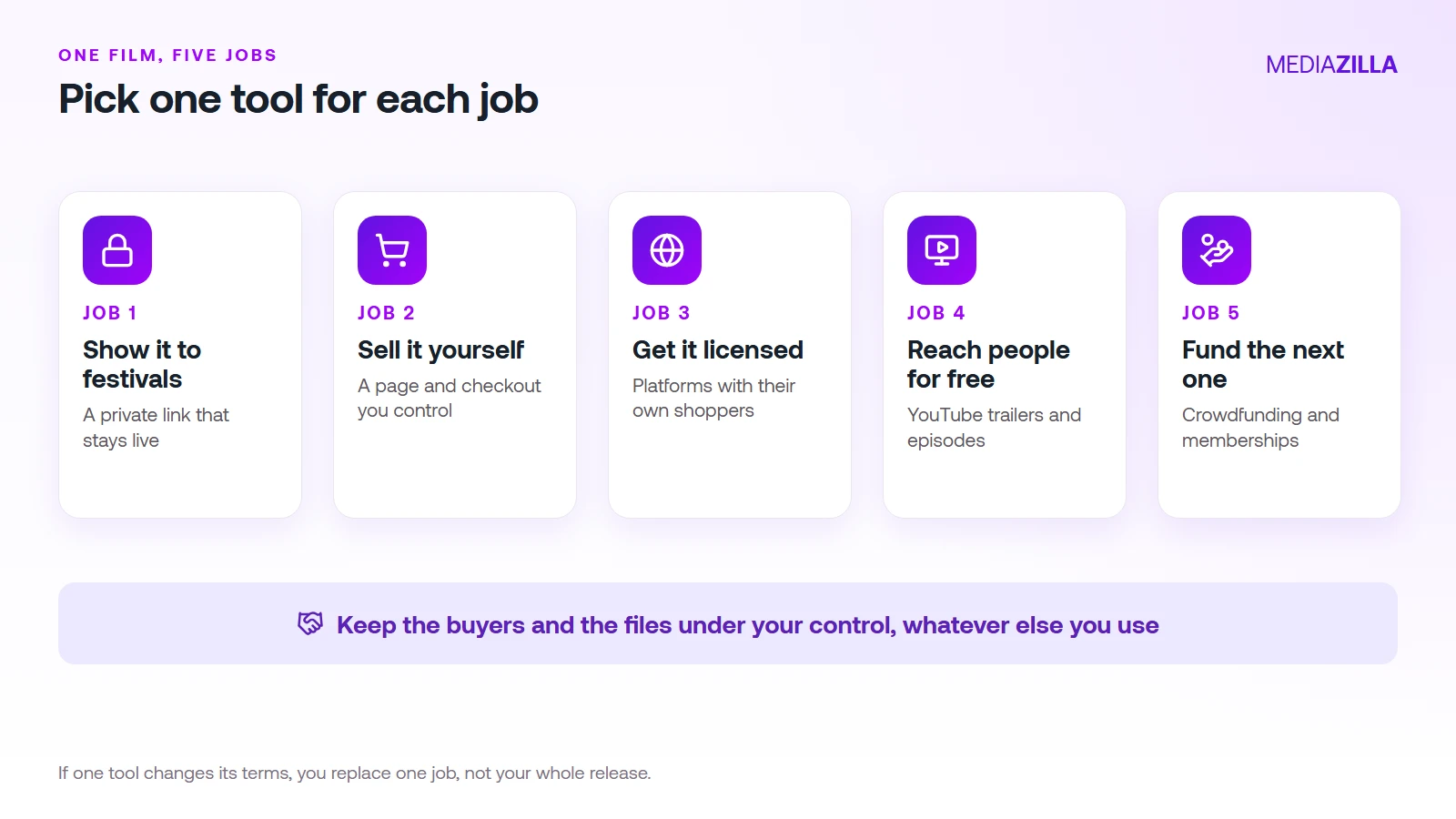
Never put your whole release on one platform.
Vimeo On Demand closed on November 20, 2026. Every seller had to rebuild their store and tell their buyers. That's what one-platform risk looks like. With a stack, you replace one job, not your whole release.
Job 1: Get Seen by Festivals
What you need: a link that stays live through judging, opens in every country, and keeps your unreleased film private.
FilmFreeway says that by default only you and the festivals you submit to can view your projects. Some festivals ask for a password and downloads turned off. Some say a changed password must be reported or the entry can be ruled ineligible. Our festival screener guide has the full checklist.
- A private link: with a password and downloads turned off, as the festival asks.
- MediaZilla: per its pricing page, Share Links can be password protected, and plans include a yearly upload quota.
- Any host: pick one you will keep paying for through the whole festival run.
Job 2: Sell It Yourself
This is the job that matters most, because it's the one where you keep the customer. You need a page, a checkout, and playback that works on a phone and a TV.
| Option | What it costs | What to know |
|---|---|---|
| MediaZilla | Growth $37 a month billed annually, with 0% platform commission. Stripe's card fees on top | Selling needs a paid plan. Yearly upload quota. Viewing on web and smart TVs |
| Gumroad | 10% plus $0.50 per direct sale, plus card processing | A general sales tool, not built for films |
| Vimeo OTT | 10% plus $0.50 per transaction on Starter, per our Vimeo OTT guide | Vimeo On Demand closed November 20, 2026, and Vimeo points sellers to OTT |
| Patreon | 10% plus processing, currency conversion, and payout fees | Built for memberships, not single film sales |
Want the numbers? Our guide to what stores and marketplaces take works through $12,000 of sales on each route. Want the plain version? Read how to sell a film online.
Job 3: Get Licensed
Licensing means renting someone else's audience. You pay with a cut, and sometimes with control.
- Amazon Prime Video Direct: free to submit. The agreement text says non-exclusive, 50% of the purchase price for purchases and rentals, and payments for subscription and ad-supported viewing based on a rate card. Amazon decides which titles it licenses.
- Roku: lists 80% to the publisher on payments it collects through Roku Pay. See Roku's fee guide.
- Letterboxd Video Store: curated, with a revenue split that isn't published. See the comparison with selling direct.
- Educational and library licensing: for documentaries with a subject people study. We found no published splits.
We couldn't read the official terms for Tubi, Kanopy, or Plex, so we haven't described them. Check their own pages.
Job 4: Get Found
YouTube is the biggest free reach channel. The rules are specific.
According to YouTube's help page, to join the Partner Program today you need 1,000 subscribers with either 4,000 qualified watch hours in 12 months or 10 million qualified Shorts views in 90 days. YouTube pays 55% of net ad revenue on long-form video.
Here's the deadline: on February 1, 2027, entry for new creators moves to 8,000 qualified watch hours or 20 million Shorts views, plus 1,000 subscribers. Current members aren't affected.
Use it for trailers, behind-the-scenes, and episodes that send people to your paid film. YouTube's help pages don't say whether a full-length film can earn ad revenue, and the reused-content policy applies to your whole channel. Check before you rely on it.
Job 5: Fund the Next One
- Kickstarter: most guides cite a 5% fee plus processing, about 8 to 10% in total. We couldn't read its own fee page, so confirm it.
- Seed&Spark: its FAQ says no platform fee, only Stripe's processing.
- Patreon: 10% plus processing and payout fees, for ongoing support.
- Grants: for example Sundance's Documentary Fund, for independent nonfiction.
Every one of these converts an audience you already have. Build the list first, and keep their emails.
Which Stack Fits You?
Our suggestions, based on the numbers above.
| Your situation | Start with | Add |
|---|---|---|
| Short film, no audience | YouTube and a page you control | A small festival list |
| Feature after a festival run | A page you control for sales | One non-exclusive licensing route |
| Documentary on a niche subject | Grants, then a page for the community | Educational licensing |
| Series or creator with followers | Memberships and YouTube | Direct sales of films and extras |
Five Ways to Get Burned
- One platform for everything. Vimeo On Demand's closure is the example.
- Exclusive deals you haven't read twice. Check territory, format, term, and exit.
- Losing the buyer. If you can't export buyers' emails, you don't own the audience.
- Cheap hosting that depends on a subscription you may cancel. Plan for what happens to the link.
- Unchecked claims. We found no verified figures for typical indie film income, so be wary of anyone who offers one.
Do This Today
- Write down your five jobs and what you have for each.
- Pick one tool per job. No tool covers two unless it's good at both.
- Check that you can export your buyers' emails and download your own files.
- Read the term and the exclusivity clause on anything you've already signed.
- Set a reminder to test your festival link from a phone on mobile data.
Where MediaZilla Fits
MediaZilla covers Job 2 and part of Job 1. A branded film page, a checkout, viewing on the web and on smart TVs, and password-protected Share Links for screeners.
The plan to look at is Growth: $37 a month billed annually, with 0% platform commission. Buyers pay into your own Stripe account, and Stripe's card fees are on top. Pro and Business add upload room, and 0% carries up. Yearly upload quotas run from 100 GB on Growth to 1.2 TB on Business, and there's a 14-day trial with no credit card.
It doesn't cover licensing, funding, or free reach, and it doesn't bring buyers. Read how independent filmmakers earn money for how the jobs combine into an income.
Ready to set up the page you control? Upload your film and try MediaZilla free.
Frequently Asked Questions About Platforms for Independent Filmmakers
What is the best platform for independent filmmakers?
Is Vimeo still a good choice for independent filmmakers?
Should I put my film on YouTube?
Is it better to sell direct or use a platform that finds buyers?
Is MediaZilla a good platform for independent filmmakers?
Does MediaZilla take a commission on my sales?
Can my viewers watch on a TV, and do buyers keep access?
What should I check before agreeing to exclusivity?
Featured Resource
Migrate from Vimeo On Demand before November 20
Apply for a free MediaZilla migration spot. Approved libraries move in 14 days, or we pay you $1,000.
Apply for free migration